
If you’ve been living with PCOS—the irregular periods, the stubborn weight gain, the acne that shows up uninvited, the hair where you don’t want it and loss where you do—you already know this condition is about so much more than your ovaries.
And now, finally, the world of medicine agrees.
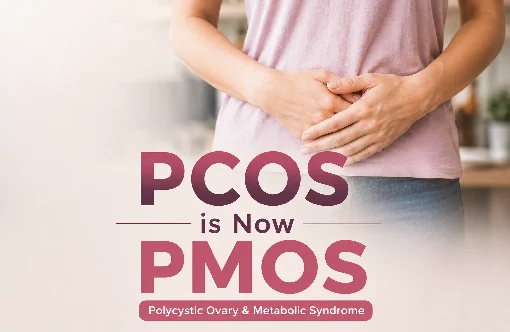
Polycystic Ovary Syndrome (PCOS), a condition affecting more than 170 million people worldwide, has been officially renamed Polyendocrine Metabolic Ovarian Syndrome (PMOS) following a landmark global consensus study published in The Lancet.
The new name acknowledges what patients have known for years—that this is not just a “cyst problem.” It is a complex, whole-body hormonal and metabolic condition.
Why Was “PCOS” Always the Wrong Name?
Think of it this way. Imagine your doctor tells you that you have a “stomach ache syndrome”—but the real problem is your liver, kidneys, and hormones all acting up together.
That’s essentially what PCOS was doing to millions of women.
When the condition was first described in the 1930s, doctors physically examined patients’ ovaries during operations and noticed they looked lumpy and bumpy, as though they had cysts on them.
However, a true abnormal cyst has a particular type of lining. What they actually saw were clusters of immature follicles—tiny egg sacs that never fully matured due to hormonal disruption.
They were not true cysts at all.
The term PCOS was inaccurate because it:
- Implied pathological ovarian cysts
- Obscured the diverse endocrine and metabolic features of the condition
- Contributed to delayed diagnosis
- Encouraged fragmented care
- Added to patient confusion and stigma
In busy cities like Mumbai and Thane, where women are juggling careers, commutes, and family responsibilities, many patients spend years being told, “Your ultrasound shows cysts, so you have PCOS.”
But there is a much bigger picture.
You Can Have PMOS Without Any Cysts on Your Ultrasound
This is one of the most important takeaways from the name change.
Many women with PMOS do not fit the narrow “classic” presentation.
Some women have regular periods. Others present with irregular menstrual cycles but do not have visible follicles on ultrasound.
This is something seen regularly in clinical practice.
A woman in her late twenties may come in with acne, weight gain around her abdomen, and irregular periods. Her ultrasound appears perfectly normal with no visible cysts. She may leave another clinic believing she is fine.
But she is not fine.
She may still have PMOS.
Up to 70% of affected individuals remain undiagnosed. A large part of that is because the word “cysts” sent both patients and doctors searching for the wrong thing.
What Does “PMOS” Actually Mean?
Let’s break it down simply.
Polyendocrine
Multiple hormones are involved, including:
- Insulin
- Androgens
- Luteinizing Hormone (LH)
- Follicle-Stimulating Hormone (FSH)
This is not a disorder involving just one hormone.
Metabolic
Your body’s ability to manage:
- Weight
- Blood sugar
- Cholesterol
can be significantly affected.
Ovarian
Yes, the ovaries are involved.
However, they are not necessarily the cause of the condition. In many ways, they are responding to the hormonal and metabolic disruptions occurring throughout the body.
PMOS is characterized by fluctuations in hormones that affect:
- Weight
- Metabolic health
- Mental health
- Skin health
- Reproductive health
For too long, the name reduced a complex, long-term hormonal disorder to a misunderstanding about “cysts” and an excessive focus on the ovaries.
This contributed to missed diagnoses and inadequate treatment.
What This Means for You as a Patient
This development is particularly relevant in India, where millions of women are affected and where the condition has become increasingly linked to:
- Obesity
- Diabetes
- Infertility
- Mental health concerns
Indian researchers have repeatedly warned that the disorder remains underdiagnosed and is often misunderstood as purely a fertility problem rather than a lifelong metabolic condition.
For many patients—especially teenagers and women in their twenties who arrive feeling confused, dismissed, or misdiagnosed—this name change is validation.
It means:
- You will not be dismissed simply because your ultrasound appears normal.
- Insulin resistance, mood changes, and skin symptoms are now formally recognized as part of the condition.
- Treatment can look beyond fertility and focus on metabolism, cardiovascular health, and mental wellbeing.
- Future research and healthcare funding can better reflect the complexity of the disorder.
The Bottom Line
This one-letter change—from PCOS to PMOS—follows more than a decade of debate and feedback from over 22,000 doctors, researchers, and patients worldwide.
It is not simply a rebrand.
It is medicine catching up with what patients have been experiencing all along.
If you have ever been told that you “don’t really have PCOS” because your ultrasound looked normal, it may be time to revisit that conversation.
The understanding of this condition has evolved.
And now, the name has too.
Dr. Arohi Tasgoankar is a Gynecologist, Laparoscopic & Robotic Surgeon based in Thane.
📞 For Consultation: +91 98330 74977
